What to watch for before, during and after a rollout.
We are joined by Dr Marcin Żółtak of what to watch for before, during and after a rollout, a Change Consultant who has worked with organisations of all sizes across different countries. His work brings together production, services and processes, and the part he likes best is the human side of change. He has run a consulting and training practice since 1996, working with over a hundred organisations across more than a dozen industries.
He guides us through six blind spots of change: hidden situations that influence how a change really runs. Each is explained through a well known, published case from industry, agriculture or Soviet history, showing these mechanisms work regardless of context. The cases are simplified to focus on the mechanism, and are not a judgement of any company, country or past decision.
The Official and Informal Life of an Organisation
 As Change Managers, we observe how organisations function, receive feedback about their needs and discuss with the board and stakeholders what should be done. On one hand, there is official information about how the organisation works. On the other, there is a number of activities beneath, and in many cases these depend on culture.
To understand a change, you need to see both how the organisation acts officially and how it acts informally. The six mechanisms follow the road we travel through a change, from the first discussions with boards and managers through to scaling and reporting results.
Blind Spot 1: Untested assumptions
The case: Walmart in Germany
 In 1997, Walmart chose Germany as a developed, organised and big market to begin growing in Europe. It brought the whole model developed in the United States, from the greeter at the door to packing goods for customers at the checkout, along with its management style. It bought two retailers, one in good condition and one in bad condition, one centralised and the other decentralised.
Without knowledge of how the market worked, Walmart was completely unprepared. It had to develop the business while solving problems that appeared step by step as it discovered the real market. Yet Walmart was very successful, a well organised team for many years, convinced its model was useful, practical and profitable. That is why it implemented it without checking reality.
How it works
The same happens in smaller successful organisations where a team has worked together for a long time. People play similar roles and see the work through the eyes of their position. Boards are often convinced the picture of change is obvious. Managers have a different picture, and employees another, and each group is convinced theirs is true.
What to do
- Ask what must be true for the plan to work
- Carry out a deeper initial diagnosis of how the organisation works and how it is managed
- Understand the cultural picture, including the managing style and how people are treated, because it tells you whether people speak openly, in groups or only individually
- Know whether the culture supports the change you plan to implement
Blind Spot 2: Absence of objection read as agreement
The case: Nokia
 In 2005, Nokia was one of the largest phone manufacturers, preparing to sell phones on its Symbian system. It was struggling with technical problems and knew Apple was about to present its new product. Teams worked under very big pressure and ambitious targets, and the culture punished poor forecasts. In meetings, the best response was silence, or saying the results were good.
As a result, the board had no idea how serious the situation was. People did not discuss it internally either: when others’ results looked so good, they questioned whether to share their own. When two people did talk, they convinced each other it was okay, so even individuals lost sight of the real situation.
How it works
A culture that pushes people to give only positive opinions leads them to present ideas and data that confirm the base assumption. This is stronger when communication is visible, and weaker when people can speak openly about problems without punishment.
What to do
- Ask stakeholders anonymously and in writing about the situation, creating a safe position from which to communicate
- Check what really happened to people who openly raised negative situations
Blind Spot 3: The cost of going first
The case: a new fault reporting system

A middle sized manufacturer with quality problems monitored faults verbally, so raising an issue was up to each person. It implemented a new system where you selected the failure, entered your name and data, and the fault was recorded. Everyone agreed it was a very good idea for improvement and management, but no one tried it. The system stayed empty, and the organisation returned to verbal reporting.
How it works
The first person to act checks the cost and the benefit, and prefers someone else to test the solution first: does it work, is it risky for me personally, does it bring positive results? Even people who think a system is useful wait for others. When the change is discussed, it is supported. When it is implemented, no one is interested in trying it.
What to do
- Give the first people to try time, protection and sometimes open support
- Select team members ready to take the risk, who can test the system and act as partners or Change Agents without any consequences
Blind Spot 4: The new way of working is invisible to others
The case: hybrid corn in Iowa

This is why pilots, and the Change Agent role between the Change Consultant and the organisation, are so important.
In Iowa in 1927, family farmers were encouraged to use a new kind of corn. It seemed very profitable, but it was expensive, and results would only show the following year. The risk
sat with whoever went first, so farmers waited to see their neighbours use it. The information reached them within one or two years, yet the whole change took about ten years. Farmers were smart: they waited until they could see how it really worked.
How it works
Communicating a change, expecting new behaviour and seeing results are different things. Communicating change is easy and cheap, which is why many boards communicate change without plans to support new behaviour and without showing results.
What to do
- Train people who work side by side in the same department, so they can see their neighbours’ work, results and mistakes, and improve together
- Show stakeholders possible solutions in other locations, such as factories, offices and services
People may say “this is not our company, they are different”. Use it positively: how do those differences influence how you can act? Boards also expect change as fast as possible. A change communicated on Friday is expected to be working by Monday, but change takes time, especially when it requires new values and new behaviour.
Blind Spot 5: Pilot conditions not transferred
The case: General Motors and Toyota in Fremont
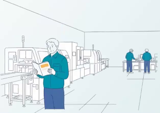
In 1982, General Motors closed its Fremont factory because of the worst quality and poor results. In 1984 it reopened as a joint venture with Toyota, with production reorganised around lean management, flatter managerial levels and managers responsible for teams. Within two years it was very successful, with good profitability and very high quality. Most attempts to transfer this to other factories were unsuccessful.
How it works
Researcher Gabriel Szulanski, who studied transfers of technology, organisation and culture, found that in many cases organisations had no idea what was working. Each organisation consists of two systems:
- The formal system: processes, structures, goals and management systems
- The social system: culture, relationships and management style
As research from Nonaka and Takeuchi shows, the social system is not transferable, so in many cases only the formal aspect is transferred.
What to do
- Concentrate on initial diagnosis, or run a long pilot so you learn which cultural aspects influence the work
- Treat each extension as a new implementation, discussing it with people and seeing how it works under new cultural conditions
Blind Spot 6: Bad news softened on its way up
The case: the removal of Khrushchev

In 1964, Nikita Khrushchev was on holiday in Georgia when the Politburo called him back to Moscow to discuss crucial aspects of Soviet agriculture. At a closed meeting, he was told he was relieved of his position and would retire. He was completely surprised, convinced that his reforms were supported and everything was running well. The person with the greatest formal power was among the last to know the truth.
How it works
No one likes to bring bad news about a change. People involved may lose positions, money or development prospects, so when reporting they are not always inclined to tell the truth. In an organisation with many levels, each level softens the message a little more, until there is a big difference between what is known at the bottom and at the top.
This is especially dangerous for an external Change Consultant. You are not a member of the team, people may not trust you, and you may be seen as representing the board. Unlike Nokia, where trust was absent, here people trusted each other in small groups and knew exactly how things stood.
What to do
- Look for this mechanism deliberately at the beginning of the change
- Check what happened to the last person who brought bad news, and whether the culture is open or closed
- Engage Change Agents from the beginning, so you know how the bottom of the organisation works and communicates
How the Six Blind Spots Connect
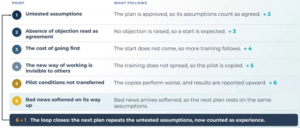
These mechanisms build on each other. A plan is approved on unrealistic assumptions. The start goes ahead with no objection, so wrong assumptions combine with a false sense that all is well. No one tests the new solution, at the very moment time, money and reputation are invested. The new way stays invisible, so no one knows if it will work at scale. The pilot fails to transfer. Finally, the real situation is not reported, and the next round starts from the same wrong assumptions.
Knowing is not enough
It is easy to say people should have known. In many situations, they already did. The solution is to test your assumptions with different kinds of stakeholders, not only boards with their own picture, but different levels of the organisation that may tell a different story.
Three Practical Rules for Any Implementation
1. Ask the hard question directly
Ask not “Do I hear objections?” but “Who has started, and who is waiting?” The most important question is why someone does not join a change, and what blocks them. When five people in a room say it is a great idea, what about the others?
2. Make bad news safe to bring
Ask board members who could tell you a different story. If the culture is rather closed, set up an anonymous routine to collect data, information and opinions.
3. Compare sources
Confront the stories you collect, from employees, the board and management, to see the differences, what Marcin calls the field of change. Within the diagnosis, ask: how do I know what they tell me, and can I assume it is true?
Culture runs through every blind spot
Across all six mechanisms, culture has a big share in whether a change succeeds. Knowing how people really communicate, what happens to those who speak up and who is waiting gives Change Managers a far more accurate picture than formal reports alone.
Watch the full session
🎬 Members can watch the webinar on the MEMBER HUB
🤔 Not a member yet? Now is a great time to JOIN HERE NOW