
Build clarity before the cascade begins.
We are joined by Thérèse Walsh, Co-lead of the Change Management Institute Ireland Chapter and founder of TW Performance Solutions. Thérèse is a senior Change Management consultant and leadership advisor with over 20 years of experience leading organisational change across financial services, the public sector and multinational organisations. Winner of the Change Leader Award 2025, she specialises in turning complex change into clear, practical actions that engage people and deliver sustainable results. A certified Prosci® Change Practitioner, she has worked with organisations including the Central Bank of Ireland, CBRE, the Arts Council, Kellogg’s and BNP Paribas.
Thérèse guides us through a chapter of the Change Practice Playbook, converting what is written there into practical steps and actions you can take to define your next change programme before you start to manage it.

Why defining change is important
When change is clearly defined:
- Leaders align around the same change. Senior sponsors and project teams spend a lot of time designing the change, so in their heads it is clearly defined. Defining it for the leadership cohort right at the start, with the opportunity to question and share feedback, helps them align before you cascade it wider
- Managers can explain it consistently. Managers are often asked to deliver change pretty much immediately after hearing about it for the first time. Involving them in the definition process helps them explain it to the people most impacted
- Employees understand what is changing and why, which helps them come to terms with what is happening and see the end outcome
- Impacts can be identified earlier, including things overlooked, missed or not known at the design stage
- Resistance and uncertainty can be addressed
- Change activity can focus on adoption rather than clarification
Resisting unclear change. Thérèse came into one organisation late in a change. The sponsors and project team were clear on the change and told her there was a lot of resistance at director level. When she met the directors, they were not resisting the change, they were unclear on the change. It was not resistance to change, it was resistance to unclear change. By defining it early, you remove the uncertainty that might create resistance, and you can focus on adoption rather than on clarifying the message when it is too late.
Put simply, clarity builds alignment and creates action.
Six questions to define the change 
None of these questions will be strangers to anyone involved in change programmes, but each one matters:
- Why? The problem or opportunity is key to defining any change
- What? A more consistent approach, clearer lines of reporting, improved systems? It might seem obvious, but people assume others know, and they actually do not
- From/To? What is changing and what isn’t is another way of looking at this
- Who? The audience is critical. Don’t define the change only in the words of the senior sponsor; make sure the why is clear to the people impacted
- When? Share a roadmap. It doesn’t have to be perfect and it may change over time, but it gives people something to work towards
- Success? Implementing a CRM solution and training 200 people shows the change has been implemented. The change landing is 90% of customer interactions being recorded in the new system. That is success
What is changing? What isn’t?
When you define what is changing, people can automatically think everything is changing, and it becomes overwhelming. What works, and the Change Practice Playbook looks at this in some detail, is to be open about what is changing while also being clear about what is not.
What might be changing
- Processes or ways of working
- Roles or responsibilities
- Technology or tools
- Behaviours or capabilities
- Customer or employee experience
- Measures of success
What might not be changing
- Your role isn’t disappearing
- You will still report to the same manager
- Our customer commitments remain the same
- The existing system will continue to be used during transition
- Our core purpose and values aren’t changing
- This change doesn’t affect every team
In one organisation where the level of change did overwhelm people, it helped managers a lot to sit down and look at what was staying the same. It is that reassurance piece: yes, a lot is changing, but this is what is going to remain the same. It is only human nature to think the worst. You hear that a process has changed and automatically think the whole world is changing, but it isn’t.
 Change happens at a point in time, transition doesn’t
You might implement a CRM system, it has gone live and people have been trained, but getting to 90% of customer interactions input into the system takes time. Clearly defining the change helps during that transition from current to future ways of working, but it won’t solve every problem.
The more project managers, senior sponsors and leaders can acknowledge the transition period, the better. There will be uncertainty, questions and more learning needed, and there might still be a bit of resistance, and that’s okay. Encourage experimentation, such as small focus groups working on the new ways of working, adjusting as you see fit, and put steps in place to manage risk during transition.
Defining the destination doesn’t remove the transition, it just gives people something clear to move towards. If there is a bump in the road and people know what is coming at the end of it, they get back up again rather than stay down.
From business case to change story
A business case might explain why the organisation should invest in the change. A project plan might explain how it will be delivered. Neither necessarily gives people a reason to care about it, and people don’t necessarily care about facts and figures. To define change in a way that resonates, is adopted and lets people see the rationale for it, start converting that business case into a change story.
 Every change story needs five chapters:
- The case for change. There is still a burning platform, a reason why we are changing. Start with what works well today, because there is always a list of things people are doing well. Change doesn’t always happen because people are failing, it just means something needs to be done differently. Then talk about what is not working today:
- Resources tied up reacting to issues
- Inefficient processes causing staff frustration
- Lots of data, but no clear way to access the right information quickly
- Many different systems in use
- The destination. When training on change stories, Thérèse puts up a picture of a beach. What’s your beach? Think ahead two or three years: if this change happens, what are the benefits, what are you seeing, what is your experience? It might be a really interesting, challenging role with less admin, much better systems and clearer escalation lines
- The journey. How we get there, and what we need to do to get there in the best way. The journey involves a lot more than defining the case for change, and is a mini masterclass for another day
- What it means for you. Translating the change into what it will mean for each team
- The conversation. Every change story needs to end with a conversation with the people you are delivering it to
Don’t broadcast change, cascade a conversation
How you deliver a change story is nearly as important as the content you deliver. Cascading through the leadership team, through managers, to teams gets you the right feedback to ensure you have engaged every person in the organisation.

- Leadership. Leaders share one core change story, so there are no competing versions
- Managers. Given time to think about the change, managers can localise it and make it real for their team. A customer service manager can bring examples from a customer service perspective, and the same applies in settlements or operations
- Teams. The cascade should always be face to face and two-way, or virtually two-way
- Feedback. Feedback is a gift at this stage, informing subsequent messaging and implementation
Being a little controversial, Thérèse believes delivery is actually more important than content. Great content with poor delivery is lost, because the context and space to question weren’t provided. Poor content delivered effectively, going beyond the content to make sure everybody understands, gets a much better end outcome.
The downside of a cascade is that it takes more time than a town hall that is one and done. But change communication isn’t complete when the message is sent. It starts when people begin talking about what the change means for them. Sending something doesn’t guarantee it is understood, or even read.
Don’t ask “any questions?”
 Ask “any questions?” and you will get no questions, or silence. Don’t overcomplicate it either, as too many questions leave people unsure how to answer. Instead, ask the people you have just spoken with to stop, reflect on what they heard, and consider four questions:
- What resonated with you?
- What questions or concerns do you have?
- What would help address those concerns?
- What haven’t we considered?
By asking these four questions you encourage feedback and get people’s thoughts, and you might get some gold dust: things that haven’t been thought about, or that will be very useful as you move forward.
The change canvas
Everything comes together in the change canvas, a simple way to build the vision, consider the people experiencing the change and get clear on the outcomes you are trying to achieve.
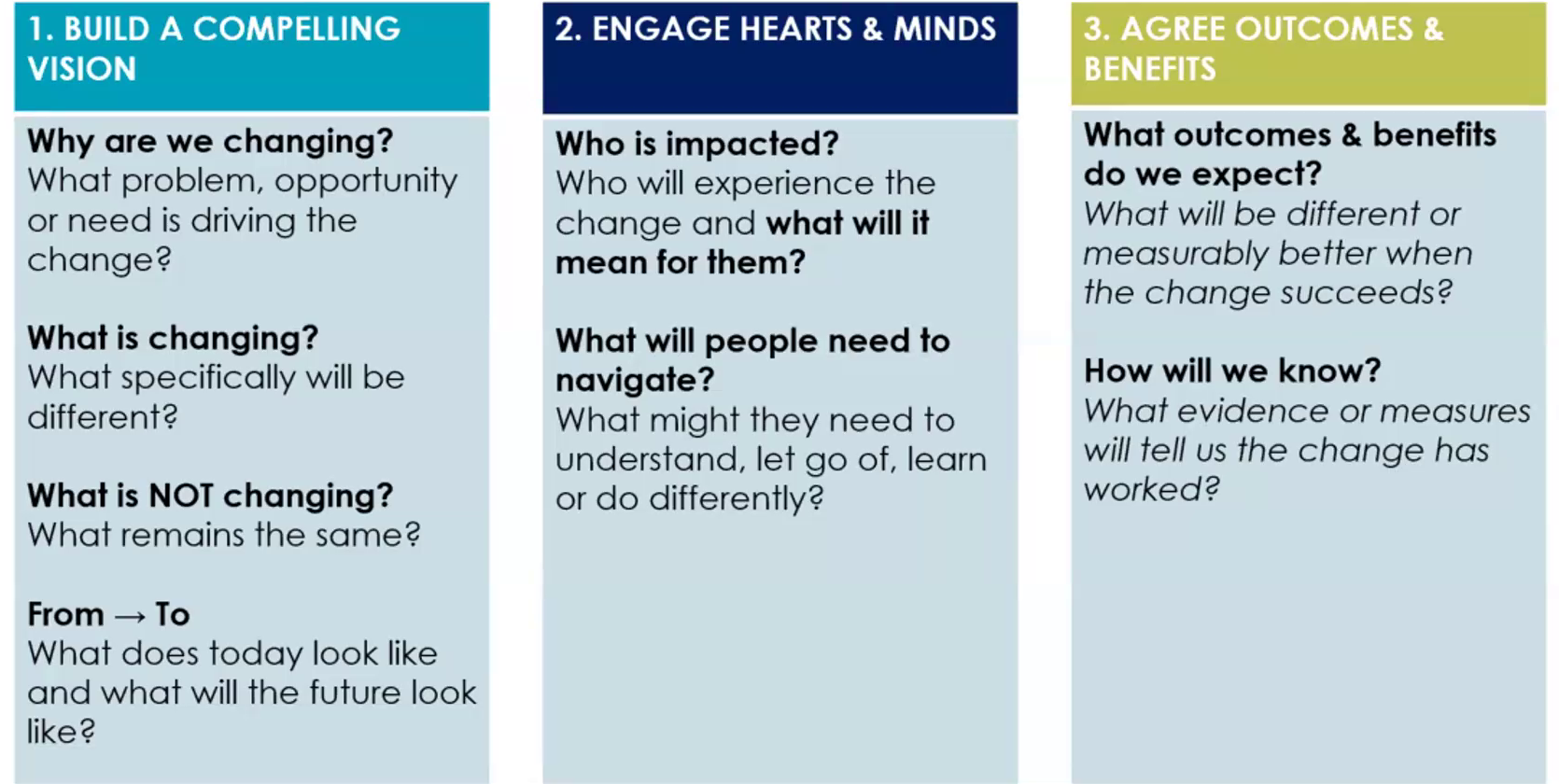
Step one: build a compelling vision.
Write the why down as simply as you can, getting senior stakeholders involved, then set out what is and isn’t changing. The from is normally the frustrations, the chaos, the day in, day out bugbears. The to is the beach.
Step two: engage hearts and minds.
Beyond who is impacted, consider what people will need to navigate. This is less about moving from an old system to a new one, and more about what people might need to let go of and where they must step out of their comfort zone, in the spirit of William Bridges’ work on transition. Double click on the problems the change will solve, or on what the new way might look like, to make it real for people.
Step three: agree outcomes and benefits.
It isn’t that go live has happened and 200 people are trained, it is that 90% of staff are using the tool to interact with clients. That won’t be immediate, so never assess adoption the day after implementation.

Thérèse’s Top Tips
A few top tips to remember when defining change and developing it into a change story:
- If you can’t explain it simply, you’re not ready to communicate it. If it takes three pages to explain something that should be on one slide, go back and simplify
- Define what’s not changing too.
- Don’t confuse implementation with transition.
- Define success in terms of adoption, not just implementation.
- Involve middle managers early, don’t just hand them the story. This is the key to success. Managers are the layer everybody looks to for support.
- Cascade, don’t broadcast. It takes more time, but short term pain is long term gain.
- Create space for people to question and challenge. Only one or two brave souls will put their hands up at a town hall of 200 people, but far more will ask a question when sitting with their direct manager and a team of 10 around a table.
Bringing it together
Defining change well starts with the why, is clear about what is and isn’t changing, respects the transition, and turns the business case into a change story that is cascaded as a conversation. The full session also includes breakout discussions on aligning executives before the cascade and reining in communicating too much, too soon.
🎬 Members can watch the webinar on the MEMBER HUB
🤔 Not a member yet? Now is a great time to JOIN HERE NOW