Treating behaviour change as a systems problem rather than a persuasion problem.
Most change efforts try to persuade people to behave differently. Justin Balaski, owner of IdeaLeap and Lean Change and creator of Friction Mapping, takes a different view. He treats behaviour change as a systems problem rather than a persuasion problem.
His slogan is simple. Make it easier to do the new thing, make it harder to do the old thing.
Here is a taste of what the session covers.
Behaviour follows the path of least friction
Left alone, people take the easiest route, and over time that route becomes the way things are done. Justin’s own example makes the point. When his office fridge broke, the food moved to a fridge in the garage, around the corner and out the side door. In the week before the replacement arrived, six pounds disappeared. Nobody said eat less. The environment changed.
Friction is the most powerful lever you have
Push communications and training are our weakest levers. Friction is the strongest. It is a function of effort and cognitive load, and it compounds daily, while motivation has to be renewed daily. Remove the friction and the behaviour sustains itself.
The framework is refreshingly simple. If the new thing is not easy, make it easier. If it is already easy, ask whether the old thing is still easy too. If it is, make it harder.
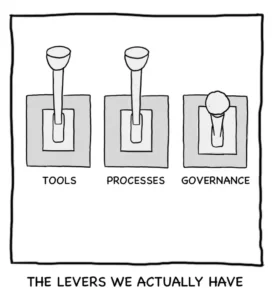
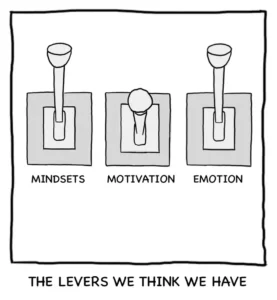
Manage constraints, not mindset, emotions or motivation
Mindset, emotions and motivation matter, but there is no lever in anyone’s head that we can switch. The levers we do have are constraints such as tools, processes and governance. If you want to change behaviours, change the constraints in the system, then step back and see whether the behaviours you want start to emerge.
Building a friction map
The session works through a real scenario. A corporate travel booking tool has been live for nine months, yet 70 per cent of trips are still booked outside it, even after training. The six steps of the friction map are:
- Define outcomes, current and desired
- Define the specific behaviours needed from leaders, managers and the frontline
- Identify the constraints that enable or restrict those behaviours
- Map the constraints by their friction on the current and desired behaviour
- Indicate the effort needed to shift each one
- Adjust the gradient by pairing each constraint with an intervention
Water finds the low ground, and behaviour does too. When friction on the current behaviour is greater than friction on the desired behaviour, behaviour rolls towards what you want to see.
The question to ask leaders
When a leader asks whether the map can be done, there is one question to put back to them: what are you willing to accept? The boldest intervention gets you what you want immediately, but it can carry real disruption. Just because something is right for adoption does not mean it is the thing you want to do.
The map is also a forecast. Treat every intervention as an experiment, run small tests, and try something else if the behaviour does not follow.
What you will find in the full masterclass
- The world’s simplest behaviour change framework
- A step by step build of a friction map, from outcomes through to interventions
- How an AI powered friction map acts as a thinking partner, including a live build
- An extended question and answer discussion on friction mapping in discovery when confidence is low, treating time and cost as constraints, and getting buy in from leaders
🎬 Members can watch the webinar on the MEMBER HUB
🤔 Not a member yet? Now is a great time to JOIN HERE NOW