Turn data into insights that earn executive attention and action.
We are joined by Euan Wu, Managing Director of The Change Compass, in conversation with Jane Judd. Euan is a pioneer in how to capture, interpret and use change data in organisations, with a global client base and a collaborative working approach. Jane has been a member of the Change Management Institute for well over ten years and joins from New Zealand.
Together, they explore the mindset of change intelligence, along with practical insights and tips on how to build it. Euan also shares some of the benchmark insights captured across his client base around the world.
What change intelligence means
Change intelligence has three components.
- The change brain: a data-driven brain for the organisation that captures its institutional knowledge around change, whether you call it a change intelligence platform, a hub or something else
- From static reporting to compounding intelligence: moving beyond reports on individual projects to a history of sound data that you can interrogate, learn from, and use to predict the future
- What it lets you do: avoid collisions, optimise business performance, predict readiness and risk, and make decisions with confidence because they are based on data
Why this matters now
For the past 10 to 20 years, much of the work has centred on digitisation, and now the focus is AI. With more and more data and the help of AI, Change Practitioners can take things to the next level. Change is no longer only project-driven or business unit driven. It is about everything, including the history of the change you have been working on.
From a point in time to patterns over time
Many Change Managers report at a point in time on a phase of a project, or on what is coming up next quarter. With a history of change, you can surface insights, trends and patterns, such as:
- Times of the year that are much busier for certain teams or business units
- Stakeholder groups where particular strategies and tactics have not worked well in the past
- A leadership technique another business unit has used successfully to drive change
How the change brain works
Data compounds over time. The steps are to capture, aggregate, benchmark internally or externally where possible, and then use that to predict outcomes and make recommendations.
Stakeholders ask to see the data. They are not interested in personal opinions or what is heard down the grapevine. Hard data becomes your defence and your armour for driving difficult conversations with executives.
What feeds the brain
Feed the brain as much history as you can, including:
- Impact data
- The list of your initiatives and the volumes of change they create
- Adoption data
- Readiness data
- Capacity and loading data
If you do not have capacity and loading data, many organisations start with the front line, as those most sensitive to change. Ask how much allowance they have for work other than servicing the customer, then overlay what happens to service agreements and performance when that allowance is exceeded.
Start with what you have
Everyone is in a different situation. Any amount of data is something you did not have before, so build on it:
- Capture basic information from your current project
- Share data with a Change Manager colleague on another project, as sharing across two or three projects is much better than holding data within one
- Compound across business units and projects, over months and, ideally, years
You can start with a spreadsheet, with columns to capture impact, saturation levels, business units and readiness. Over time, you can use AI to help structure the data and extract the patterns. Keep your qualitative data too, but where it makes sense, turn it into ratings, levels or percentages so it is easier to aggregate.
Why change intelligence matters
Change intelligence is not an interesting side project. Better insights lead to more powerful recommendations, and avoiding change collisions is something executives care about right now, especially as AI increases the volume of change. Executives also care about the top line and the bottom line:
- The bottom line is cost, which includes capacity
- The top line is revenue, for example when salespeople are impacted
With the intelligence and the patterns, you can potentially quantify that impact in dollar terms. Imagine telling executive stakeholders that a decision may risk performance by 10 or 20%, which means a million dollars. Every stakeholder pays attention in that situation.
 Collisions land on the front line
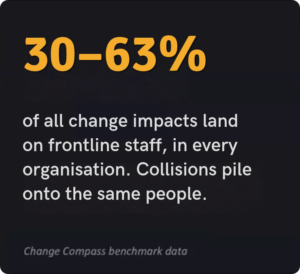
Across the organisations in the benchmark data, between 30 and 63% of changes impact the front line, and any time you impact the front line, you impact the customer. Every initiative might look green on its own when reporting to a steering committee. When you look at the compounded impact on people, it can be quite a different situation.
 Embedding is under-resourced
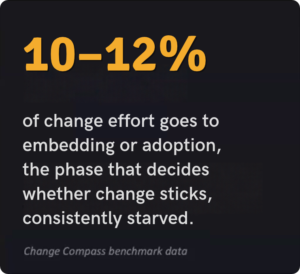
On average, only 10 to 12% of change effort across the life cycle goes into embedding or adoption, even though embedding is when the rubber hits the road and the benefits are realised. Implementation, or go-live, is when the change actually starts, and leaders require support over that time as much as anyone else.
 Light activity is the norm
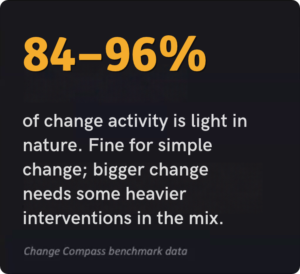
Most change activities across most initiatives are light in nature, such as communications, town hall sessions and quick team briefings. Yet big, heavy changes that impact behaviours and the operating model would be expected to include more coaching and workshops. This raises some important questions:
- Are interventions designed to reflect what the project and the business require?
- Or are they moulded to the time available with frontline and other impacted teams?
- Are all activities being recorded, including organisational redesign and co-design workshops, or only well-known activities such as communications, training and stakeholder analysis?
Influencing for adoption
Project managers often dictate the priorities, so take the perspective of the business leaders impacted by the change. They are often accountable for realising the benefits, so help them get there:
- Ask what they care about most, whether that is bottom line savings, efficiency or productivity
- Work with them to track and monitor those goals
- Turn that tracking into metrics, and use the metrics to influence the project
Tailor your recommendations to what each leader cares about most. A CFO ideally looks for things in dollar form, while a head of operations cares about productivity and throughput. The data has to be in formats they understand, using their language.
What to share with senior executives
The Barbara Minto model works well, especially with executives:
- Recommendation: lead with your recommendation, your top line
- Why: explain why you are recommending it, for example because of the risks, the impact on the business or performance
- Detail: go through the details and the data that substantiate each element
Going in with the details first overwhelms executives and leaves them unsure where to focus.
Do not assume a heat map is the answer. If it is all light, all blue or open to challenge, use a bar chart instead and highlight a single bar. Show what happens to the business if the decision is not made, because the aim is a decision, not interesting data.
Measuring the value of Change Professionals
Measure your value from the perspective of your key stakeholders, in terms that resonate with them, not in your terms. Ways to quantify your value include:
- Collisions avoided at particular times throughout the year, and the risks mitigated as a result
- Capability improvements turned into a performance measure, such as improved change leadership leading to improved change outcomes
- A conservative estimate, such as 10%, multiplied across all the changes throughout the year
When you start measuring, especially at a business unit or enterprise level, you often find your value is at least in the hundreds of thousands of dollars, if not in the millions, depending on the size of the organisation.
Building change intelligence
Building change intelligence takes the courage to start and to continue to grow. It is a fascinating area and an exciting one for the future, and it asks Change Practitioners to embrace it and let their skills, capabilities and organisational contribution evolve.
Change Portfolio Management training
Change Portfolio Management takes an enterprise-wide view of change. It looks across multiple initiatives happening at the same time and considers their impact, risk and the organisation’s overall capacity for change. It is a specialist skill that blends data and insight with senior-level decision-making, helping leaders adjust priorities, pacing and resources so that change initiatives can succeed together, not compete with one another.
The Change Management Institute’s Change Portfolio Management training focuses on the skill sets and capability required to work at the enterprise level. Foundation and Advanced courses are each held over multiple half-days.
See upcoming dates and times for Change Portfolio Management Training
Watch the full session
🎬 Members can read the full article and watch the recording on the MEMBER HUB
🤔 Not a member yet? Now is a great time to JOIN HERE NOW