Lived experiences heard: real voices, real change
World Mental Health Day, 10 October 2026
This article touches on mental health. If it raises something for you, or for someone you know, please reach out to your Employee Assistance Programme, your doctor or a local support service.
I have spent much of my career working alongside people in change: people going through restructures, teams implementing new systems, leaders trying to hold teams together through uncertainty. In government, long before psychological safety became common workplace language, I supported employees and leaders in distress while the systems around them struggled to respond.
One thing I have learned is this: People usually know far more about what is happening to them than we give them credit for. That is why the World Health Organization’s theme for World Mental Health Day 2026, “Lived experiences heard: real voices, real change”, resonates so strongly with me.
Listening is not the same as influence
Organizations have become very good at asking people to talk. We survey them, invite them to focus groups and hold town halls. Then, sometimes, we go back into a room and make the decisions without them. That is not the kind of listening that creates change.
The World Health Organization is deliberately challenging this. Its 2026 campaign recognizes lived experience as a form of expertise and calls for people with lived experience to influence decisions, co-design services and participate throughout planning, implementation and evaluation. People should be partners with a real say, not a box to tick.
“For those of us working in organizational change, it asks a fundamental question: Are the people experiencing our change able to influence it?”
The people experiencing the change know things we do not
As change practitioners, we bring frameworks and experience. Our subject-matter experts bring technical knowledge. The leaders bring context and decision-making authority. And the person sitting inside the change knows what it feels like at 10:30 on a Tuesday morning when the new process does not work:
- They know which workaround everyone quietly uses.
- They know where the hand-off continually breaks down.
- They know what customers, patients, employees and community members are actually experiencing.
Lived experience should not compete with professional expertise. It should sit alongside it. When identifying the expertise needed for a change, ask: who understands the system, who operates it and who experiences it? If the third group is not meaningfully represented, there is probably a gap in your change approach.
Start with the people most affected
Uncertainty, loss of control and constant change weigh most heavily on people already living with mental health conditions, on many neurodivergent colleagues, and on those whose distress nobody at work knows about. They are rarely the people we consult, yet they are often the first to see where a change could cause harm. ISO 45003 lists organizational change management as a psychosocial hazard, so listening to them is part of managing risk.
Ask, before the plan is set:
- What will this change require from people, and what might they lose?
- Which groups may experience the greatest impact?
- How will we recognize if the change is creating harm as well as progress?
Psychological safety is not a policy document
Organizations regularly tell people: “We want your honest feedback.” But before someone speaks, another conversation may be taking place: Is it safe to say this? Will I be labelled negative? Will anybody do anything?
Make it easier to speak up. Offer more than one way to contribute: one-to-one, in writing, anonymously or through a trusted colleague. Share questions in advance, so people can take things in at their own pace. A policy can describe a commitment, but it cannot, by itself, create trust. Trust is built through repeated experiences of being heard, respected and protected.
Coaching cannot become a band-aid for poor systems
These interventions can have value, but they cannot compensate for chronic overload, unsafe conditions or repeated breaches of trust. Sometimes the individual needs support. Sometimes the system needs to change. Our responsibility is to know the difference.
“Too often, our organizational response to stress and burnout becomes another band-aid – another resilience workshop, wellbeing initiative, tool, or reminder to manage our energy.”
Do not extract people’s stories
We should be very careful that lived experience does not become another organizational commodity. We put it on a slide, quote it in a presentation, use it at a conference. Everyone talks about how powerful it was. But nothing changes.
“We need to ask: Are we listening to learn, or are we collecting evidence that consultation occurred?”
Never make disclosure the price of being heard. People should not need a diagnosis or a compelling personal story before they are treated with dignity. This matters even more as organizations use AI to capture sentiment and stories: speed is not the same as care, and a deeply personal experience should never become just a word cloud.
Close the loop
Co-design is not inviting people into a workshop after the solution has been created. It shares influence earlier, and requires honesty about what is fixed, what is open to influence and who decides. Then comes one of the simplest and most powerful things we can do as change practitioners: Go back – tell people what happened.
I use a straightforward approach:
- You told us…
- We learned…
- We changed…
- We could not change…
- Here is why…
“We do not have to implement every suggestion. Listening does not mean handing over every decision, but respect requires us to show people that their contribution went somewhere.”
Six questions for your next change
Before your next stakeholder session, project meeting or change initiative, ask:
1. Whose lived experience is missing? Who will experience the consequences of this decision?
2. Have we involved people early enough to influence the solution?
3. Is it genuinely safe to disagree with us?
4. What are we actually prepared to change? Do not promise influence where none exists.
5. How will people know their contribution mattered? Close the loop.
6. Where is People & Culture? As a partner in shaping the human implications of the change, not the messenger at the end.
From voice to influence
Every organizational change eventually becomes someone’s lived experience. The policy becomes someone’s working conditions. The technology becomes someone’s workflow. The restructure becomes someone’s uncertainty. The transformation program becomes someone’s Tuesday morning.
Our role as change practitioners is not simply to help organizations communicate change to people. It is to help organizations hear the people experiencing it, and to have the courage to ask:
We asked people to speak. What are we prepared to change because we listened?
That, for me, is where real voices begin to create real change.
—
If this article raises something for you, or for someone you know, please reach out to your Employee Assistance Programme, your doctor or a local support line. Our ‘Mental Health for Change Professionals’ article also shares practical advice on looking after yourself while supporting others through change.
—
About the Author
Pauline Melnyk, MCC, is an organizational change and leadership development practitioner, executive coach, educator and advocate for more human-centred and sustainable workplaces, with more than 25 years of experience across government, health care, municipalities, education and community organizations. She is Director of Melnyk Consultancy Ltd and a member of the Change Management Institute Sustainability Steward SIG. This article was written on behalf of the Institute’s Sustainability Special Interest Group.
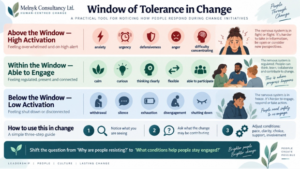
A little tool I’m including from my desk: The Window of Tolerance, a term coined by psychiatrist Dan Siegel, is a useful reminder in change that what we often label as resistance, disengagement or poor behaviour may actually be a sign that people are overwhelmed, shut down or struggling to stay within the conditions they need to think, participate and adapt.
Want more?
🎬 Members can read the full article and access resources on the MEMBER HUB
🤔 Not a member yet? Now is a great time to JOIN HERE NOW