Shifting culture through moments that matter and observing behaviours, one habit at a time.
We are joined today by Abigail Schoenheimer, founder of Second Look Advisory. Abigail is a culture and organisational performance specialist who has spent more than a decade helping organisations better understand their culture, across consulting and in-house roles with organisations including PwC, Macquarie and HSBC. She is known for helping organisations take a second look at the assumptions, behaviours and habits that shape performance.
Abigail guides Change Managers through a practical case study showing how teams can move beyond value statements. The central idea: culture behaves like personality. It does not transform overnight, but it can be deliberately shifted, one moment and one behaviour at a time.
When something goes wrong, the report says culture
Look at the reports into KPMG, the ASX or the Star and the same word appears in every one: cultural root causes, cultural failings. When something goes brilliantly, nobody commissions a review of the team that had its best year ever, yet culture was probably a driver there too. Culture decides how things turn out in both directions.
Most leaders already know culture matters. The harder question is what to do about it.
Three briefs that hit the same ceiling
- Fix our culture: follows an incident, near miss or report finding. Training completion, attestations and new codes of conduct prove you did something, not that anything meaningfully changed
- Refresh our values: a value has to work for the graduate and the exec, the sales team and internal audit, so in fitting everyone it fits nobody in particular
- Train our leaders: the right instinct, but leaders are back to normal by Wednesday. Be authentic gives no clarity on what to do at 10 o’clock on Tuesday
Each of these has the same ceiling. They are things you deliver to people, and culture is not a deliverable. It is habits. It changes through the course of a lot of conversations, not through communication. Either you manage your culture or it starts managing you.
Repeated, specific, observable
- From reactive to repeated: work on the situations that come around every week, not the last incident
- From generic to specific: behaviours that fit one team in one situation, not values that fit everyone
- From vague to observable: asks people can see being done
Culture is never the urgent thing. There is always a deadline or a fire, but more often than not, culture is what quietly lit that fire somewhere else.
Culture behaves like personality
If your organisation were a person, how would you describe them? Risk averse, siloed, well meaning but can’t quite deliver, or perhaps disconnected excellence. Notice how easy that is. Nobody asks about values or shared beliefs. You instinctively describe a personality, and the metaphor gives three useful framings.
- It is durable: you do not go to a two-day offsite and come back a different person. Programmes promising measurable culture change in six months tend to find the underlying disposition reasserts itself
- It is not good or bad, it just is: the trait that makes a team brilliant under pressure can make it sloppy when things are calm. Specific behaviours, however, can be good or bad
- Understanding comes first: a coaching relationship often starts with an assessment such as DiSC, Hogan or Myers-Briggs, not to judge, but to show your tendencies, strengths, blind spots and shadow sides. It is the same with organisations
Work with what you’ve got
- Leverage what is already strong: Macquarie breaks a lot of rules about what a good culture looks like in other contexts, but it works for them and they are smart enough not to mess with it
- Minimise what is costly: be honest about the traits working against you and manage their impact deliberately
- Not an option: downloading a new personality
Calling these programmes cultural transformation sets them up for failure, when the best we can do is manage culture in support of our outcomes.
Traits versus behaviours
Entitlement, politics, silos and hierarchy are cultural traits, and they will not change easily. What we can change is behaviours. Playing the compliance card to shut down a conversation is a behaviour you can shift. So is multitasking, even when a trait underneath says we always need to be busy. That distinction is the lens to bring to every culture change opportunity.
Moments of truth: a lesson from Scandinavian Airlines
In the 1980s, Jan Carlzon became CEO of Scandinavian Airlines (SAS) while it was losing money fast. His idea was moments of truth: every contact a customer had with the airline, such as checking in for a flight, disproportionately shaped their entire view of it. By his estimate there were about 50 million of these 15-second interactions a year.
- First, he got clear on what good looked like: a problem at the counter gets solved there and then by the person in front of the customer
- Then, he changed what was in the way. Frontline staff had to escalate problems, so he pushed decision making down to the front line
He did not ask everyone to smile more. Within about a year, the airline went from losing money to a solid profit.
Moments that matter
Turn that lens inward and you get moments that matter: the handful of recurring situations that shape how we do things here far more than any value statement does. Handful, because a team has a few, not hundreds. Recurring, because it is not a restructure or a crisis, it is what happens daily or weekly.
Why values alone rarely change behaviour
Values have to be generic enough to apply to everyone, from the call centre to the trading desk. Integrity has to mean something to a salesperson closing a deal and to an auditor flagging a control gap, so on its own it means nothing specific to either. The numbers show it:
- Second Look Advisory analysed the 493 values of the ASX100, and half the companies have some version of act with integrity
- Enron’s values were communication, respect, integrity and excellence. Nearly 25 years on, 45% of the ASX100 have at least one of them word for word
Case study: a finance function after a near miss
A global organisation, with a finance function of more than 500 people, had a serious near miss in its reporting. The board hauled in the CFO and said it can never happen again. A new layer of controls and systems followed, but controls are necessary, not sufficient. People find their way around processes, often through shortcuts under pressure rather than malice. Next came new values, and they were fine.
A function that thinks in evidence
Finance people tend to be trained and rewarded for traceability. If it is not in an email, it did not happen. But if the safe thing is to write it down, the risky thing is to say it out loud, ask the question or challenge a number with no record. People send the email, wait, and the issue sits there. The function needed more curiosity and challenge, one of its new values, which meant asking people to behave against their training and the cultural personality of the function.
Top-down and bottom-up, together
The values stayed. They were not irrelevant, only not specific enough yet. Workshops asked the teams: what are the recurring situations that decide whether you get to a good outcome or a bad one? Teams defined their own moments that matter and translated them into behaviours. A finance function is very good at complying with rules it does not believe in, and much less good at ignoring a list it wrote itself.
From values to behaviours
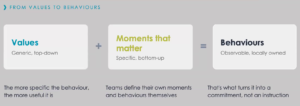
Values are generic and top-down, which is their job. Moments that matter are specific and defined by the people living them. Force the two together and you get behaviours that are observable and locally owned. Once you know the moment, ask what one of your values looks like, specifically, right here. A value is something you agree with. A behaviour is something you either did or you didn’t.
Reconciliations: pick up the phone
Reconciliations, making two sets of numbers agree weekly, monthly and at the close, became an uber moment that matters for the finance teams. It repeats across the whole function, so shifting it changes a pattern, not one team’s habit. And it is where tension lives: when the numbers don’t match, someone has to ask why.
The behaviour the teams chose: if something does not reconcile, or you don’t understand why a number has moved, don’t quietly push the report through or send an email. Pick up the phone and ask. That is curiosity and challenge stripped of poster language, something you can watch someone do or not do.
Behaviour first, belief follows
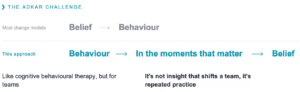
Most change models, including ADKAR, go belief first, then behaviour. This approach flips it. ADKAR works really well when rolling out a new system or process, but it was not designed with culture in mind. You define the behaviour in the moments that matter and practice it on repeat until the belief shows up: this is who we are. That identity is earned by doing the thing, not announcing it.
It is almost cognitive behavioural therapy for teams: not insight, but repeated practice.
How to find your moments that matter
- A process you run: onboarding, steering committees, month ends and project kick-offs all contain moments, generally already on the process map
- Friction points: where a project slipped or a number did not reconcile. Nobody has to decide how to behave when everything goes to plan, so this is where culture does the work
Processes tell you where the moments are. Friction tells you which ones matter.
A moment for Change Managers: the sponsor check-in
The report says green. The corridor says amber. Somewhere between what the team thinks and what the slide says, amber becomes green, not because anyone is lying, but because it is easier. This repeats on every project, and what the sponsor learns shapes whether they hear bad news early or late next time.
The behaviour, built on the value of bravery:
- When the answer is amber, say amber out loud in the meeting, and don’t soften it in the deck
- Bring one specific ask, such as “I need two weeks of your time” or “I need you to make a call on scope”
Most of us like to please our sponsor, and that trait is very natural. The aim is not to change the disposition, but to build one behaviour in one moment that holds when instinct pulls the other way.
Your turn: moment plus value equals behaviour
- Your moment: a repeating situation, ideally where things do not go to plan
- Your value: such as curiosity, humility or bravery, or one of your organisation’s values
- Your behaviour: what would that value look like in that moment?
The test: could someone film it? Be more open is not a behaviour. Ask two questions before I respond is.
The takeaway
Culture is like personality. It won’t transform overnight, but it can be deliberately shifted, one moment, one behaviour, at a time.
Watch the full session
🎬 Members can watch the webinar on the MEMBER HUB
🤔 Not a member yet? Now is a great time to JOIN HERE NOW