Discover what it is, where it hides in your work, and how to spot structural risk early.
Organisations invest a great deal right now in transformation, change capability and dedicated change teams. Many initiatives still struggle to achieve sustainable adoption and long term outcomes. In many cases the challenge is not additional communication, additional training or additional surveys. The underlying issue is probably organisational design.
We are joined today by Dr Beatrice Hofmeyr, a recognised thought leader in organisational design, transformation and change leadership. With over three decades of experience, she has led more than 400 organisational redesign projects and mentored thousands of business leaders, HR professionals and Change Practitioners in delivering successful, sustainable change. As the inventor of the SysCAP approach, a methodology grounded in human centred design and agile change principles, she champions a new, more strategic way for organisations to approach structural change. She is in conversation with David Kaczor from the New South Wales chapter, demystifying what organisational design is, why it matters, and how it helps Change Practitioners eliminate risk early in transformation.
What organisational design is, and what it is not
Half the people hearing the term will think organisational development, and the other half will think restructuring.
The first thing organisational design is not is restructuring. That is one tiny little bit of it, the part that looks at structure. It is also not organisational development, which is a key enabler of any change because it is around culture and leadership, but is a different discipline.
Organisational design is the deliberate and intentional design of the architecture of an organisation. It is not just structure, it is designing the work, which is crucial. The work has to be designed before you can design structure, roles, accountabilities, governance and decision authorities.
The thing being achieved is absolute clarity. Clarity drives adoption, engagement and performance. It aligns people with what the organisation is trying to achieve, reduces conflict and makes sure things work well.
This is where the synergy with change practice sits. A lot of change is downstream in the adoption space, and more and more change and transformation professionals are moving upstream into the design of systems and organisations. That is change engineering rather than adoption.
Where the organisational design component hides
Not every initiative carries a structural dimension. There is little or none in a like for like technology upgrade where system roles change but the work stays the same, in awareness programmes such as cyber security or work health and safety, or in brand, values and culture work, which is about mindset. A large portion of the rest does have an organisational design component:
- System change or automation, where there is a change in the nature of work. As soon as work is automated there is impact on people, on the nature of the work, on structures and on accountabilities
- Any kind of merger or acquisition
- Any stand up of a new function, where additional funding, revenue, opportunity or innovation means something new is being created
- Anywhere efficiency is being driven
- Anywhere you are trying to solve performance problems
Efficiency deserves particular attention. Organisations often cut from the top down unilaterally, taking thirty per cent off all business units and hoping for the best, which cuts deep in some areas and leaves fat in others. It is important to understand what work is done where, and therefore where the efficiency will actually be found.
The symptoms that point to design
Performance problems often show up first as people problems. Watch for high turnover, the business unit that is a revolving door, and employee engagement scores flashing red. Burnout is a sign of poor design, and you need to go back and look at how the organisation has been designed.
Unending conflict is another signal. There may be an interpersonal component where executives do not get on, but often conflict comes from lack of clarity, from gaps, from overlaps, and from confusion where people spend a lot of time trying to decode what they are meant to be doing.
A practitioner’s lens
Where an organisation sets out with clear intent to start reshuffling functions and structures, make sure you are working with an organisational design stream within your project. The question there is always how to achieve the greatest clarity and shift in performance with the least disruption to people, realigning things without throwing all the cards up in the air.
Beyond that, the aim is not to turn Change Practitioners and Change Leaders into organisational design specialists. It is to provide the vocabulary, signals and judgement to recognise problems early. Two capabilities come up repeatedly as superpowers.
Function mapping
This is about unpacking what work gets done where in an organisation, understanding the flow of work and understanding the respective accountabilities. It is not the process mapping other people do, it is about buckets of work. It matters because people’s capabilities, abilities and skills need to align with that work. You cannot give a business unit accountability for a certain kind of work when that unit has no skills to do it.
The work is often implicit and the organisation has not written it down. When they write it down and make it explicit, suddenly everybody realises why nothing is happening the way they want it to. The wrong capability is in the wrong place, or expectations of that part of the organisation have changed without it being designed to do the work. At that point a Change Practitioner can put a hand up and say here is a gap. That is the moment to look for specialist help.
Cross functional clarity
There is a lot of noise in organisations around who is responsible for what between business units, and you can find yourself in endless workshops where there is an arm wrestle over who has the A and who has the R. What organisational design teaches is how cross functional work actually happens, who does what, reducing that confusion, putting it very simply on a one pager and getting everyone aligned on it.
Practically, you can also lean on tools you already use. Flag a lack of clarity in ownership or responsibilities on the risk register as a risk, with organisational design as the potential mitigation.
The SysCAP approach
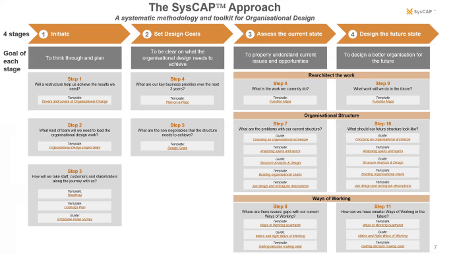
SysCAP developed because there was no good toolkit available. While delivering organisational design projects at Deloitte, tools were developed and some proved always brilliant and always worked. SysCAP is a distilling of the critical ones.
At a high level there are four stages. You initiate the organisational design initiative, you set design goals, in stage three you assess the current state, and in stage four you design the future state. A specialist starts at step one and ends at step eleven, and even then it is messy, so specialists are taught to jump around. The logic and the flow of the logic is what is critical.
Three areas are most relevant to Change Practitioners.
- Co design, in step three
Co design in the SysCAP frame is a human centred design approach to understanding the work that people do. It is not asking people to help you design the structure. Leaders have to do that. It is asking people to help you understand the work, the opportunities, the challenges, the blockages, the duplicates, the overlaps and the gaps.
Change Managers are already expert at bringing in the right people. If you do not have the right people and you are not asking the right questions, it gets unwieldy, it creates expectations you cannot fulfil and it does more damage than good. Co design is all or nothing. You either do it extremely well and get fantastic results, or you do it badly and it backfires.
This matters because when leaders prepare structure behind closed doors, it is not possible at their level to understand the nature of the work all the way down. At every level, around thirty per cent of the visibility is lost. Step three is a bottom up that meets the top down, and that is where the magic happens.
- Re-architecting the work
Across stages three and four there are three horizontal bars, re-architecting the work, organisational structure, and ways of working. It is like a sandwich. You are not going to work much in the structural space in the middle, that is where HR or organisational design do their work. The top and the bottom are the superpowers in your working knowledge.
Re-architecting the work means understanding the work being done in each area, down to role, team or divisional level, and re-architecting it intentionally. With so many practitioners working on AI and automation, it means fundamentally understanding what changes in the work and, hopefully, what makes the work more human. This is not writing job descriptions, it is having clarity on the shift in the work.
- Ways of working
An organisational structure is really a hierarchy, a vertical relationship from individual contributor to supervisor to manager to director. What it does not define is the relationship between teams. Ways of working is the horizontal connections, and HR will never capture that in an org chart. It has to be intentionally designed, using tools such as an accountability matrix, which is effectively a RACI, done in a way that makes clear who is making the decision, who is responsible and who is supporting.
When a structure lands from behind closed doors
The executive team has finalised a new structure behind closed doors that will cause major disruption, and the Change Practitioner is brought in just before the announcement to manage the change.
Leaders are notoriously terrible at re-articulating the why of any structural change. If it is cost saving or efficiency, they do not want to say it, and that is where all the jargon comes out and people do not believe what they are hearing. Ask deep questions and work with the why. Unpack the words. When the head of a unit says efficiency, ask what that means. Are we cutting staff? Are we trying to do more work?
Ask when the organisation last restructured and what people are expected to be feeling about that. There is a thing about organisational trauma, where restructures from the past have not been processed, accepted or made peace with, and the new restructure on top of that trauma gives a disproportionate reaction. That trauma can go back ten, fifteen or twenty years.
The first thing to say to an executive team that has put up a structure is not that it is a disaster and will never work. Instead ask this: in order to communicate clearly what we expect from each business unit in this new structure, can we write down the key functions for each business unit? That is function mapping. You would be surprised how, in that process, the leadership team start questioning each other about how clear it all is. Somebody says a function sits in one business unit, somebody else says no, I thought it was over here. You are teasing those things out in the executive forum, instead of during consultation with staff, where staff feel the leadership team do not know what they are doing.
Position it for the leadership team as making sure things are clear, so that when it lands, even if people do not like what is landing, they understand the expectation and there are no gaps or overlaps.
If that exercise goes well, two further questions are worth asking:
- Is there any work being automated, or any work we are stopping? Write it down, because that gives real clarity to a team. We have given you all this new work and we have not increased your staff, so here is the work you can stop doing
- Are we really clear on what we want to achieve as an outcome for this restructure? You will be surprised at how nebulous that can be, and it really helps with the change messaging. The why and the outcome are different things
Achieve even a quarter of that and you have ensured that during consultation leaders are not embarrassed, because top down restructures always leave a level of embarrassment, along with the gossip mill and the rumour mill.
The one thing to do tomorrow
Have a deep think about where lack of clarity about accountabilities and functions is creating the blockages in your change programme. How clear is it to everyone what they are doing and how they interact with each other?
Clarity is the whole goal of organisational design. Role clarity is linked to psychosocial safety, and there is a great deal of good research behind that. People in organisations take a lot of strain when clarity is not there.
🎬 Members can watch the webinar on the MEMBER HUB
🤔 Not a member yet? Now is a great time to JOIN HERE NOW