Seven actions to shape the business case, forecast accurately and influence programmes early.
We are joined by Temre Green, an Industrial-Organisational Psychologist and General Manager, Change Management at Seven Consulting, an SIA company. With over 20 years of experience leading multimillion dollar transformation programmes, Temre guides us through the critical role Change Managers can play before delivery begins, and the seven actions that set a programme up for adoption from the start.
Where does getting adoption actually start?
Executives often think of adoption as a single point in time, right at Go Live. A different view is that getting adoption starts in programme mobilisation and within the business case. In other words, adoption starts before a programme is even approved.
Programme mobilisation moves through three phases:
- Discover: establish the programme scope, objective, benefits and delivery approach
- Design: design the target programme structure and define the initial baseline, including the business case, team structure and a first view of the schedule
- Deploy: establish the team, processes, tools and forums to deliver the programme, backed by clear plans and the right governance
Seven actions before delivery begins
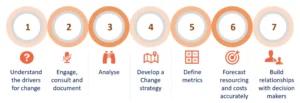
- Understand the drivers for change. The reason to do this up front is to keep a line of sight between the problem and the outcome through all of your change management activities
- Engage, consult and document. Hear what matters in the business and contribute to the risks, assumptions, issues and dependencies (RAID) register. Downstream impacts surface here, so connect the business areas before the programme commences
- Analyse. Maturity, complexity, change risks, change impacts, baseline and learning needs all provide the data that supports your approach and the level and number of Change Practitioners you put forward
- Develop a change strategy. This is a look at people, and what will get them from here to there. If your strategy is unique, such as a sandpit environment or operational dry runs for a frontline workforce, make sure it is funded up front in the business case
- Define metrics. Link change activities to the programme’s objectives, outputs and outcomes using the O3 model, and check that what you plan to measure can actually be measured
- Forecast resourcing and costs accurately. This is where everything comes together, and where Change Management expertise is critical, as opposed to someone from finance simply collecting the information. The critical inputs are a resourcing estimate, a cost estimate and an integrated schedule held in a platform such as MS Project, not on a single PowerPoint slide
- Build relationships with decision makers. Work with the sponsor, programme manager and programme management office so there is clarity on accountability for Change Management resourcing, budgeting and scheduling. Even with everything approved, side conversations can see part of the budget moved
Case study: a major platform change programme
An Australian financial services organisation is putting together the business case for the first release of a major platform change programme, an investment of $250 million over two and a half years. Over a three-month business case process, a team of 2.2 FTE delivers:
- Consultation with over 15 business groups
- A change canvas and a high level change impact analysis
- The change strategy
- Resourcing and cost estimates covering the full two and a half years
- An initial 12-month integrated schedule
The deliverables undergo rigorous assurance, the business case is approved, and release one goes live in April 2026.
Finding the Goldilocks point
Like the porridge in the children’s story, is bringing in a Change Manager too early, too late or just right?
- Too early? Even without a signed off design, you can document assumptions about what the investment in Change Management looks like, then refine them through change requests as new scope emerges
- Too late? The Change Manager is under pressure to play catch up, and it is harder for the audience to catch up too
- Just right! Engage early to influence design and plan through uncertainty or ambiguity
What? So what? Now what?
- What: getting adoption really starts in the business case and programme mobilisation
- So what: accurate resourcing, cost and time estimates matter, because this is where Change Managers can be let down if they are not involved early enough
- Now what: influence and shape the programmes you are on
The full session also includes a lively discussion on costs beyond day rates, bringing Change Managers into design workshops, the difference between a change strategy and a change approach, and practical responses for when you are told it is too early to bring in Change Management.
🎬 Members can watch the webinar on the MEMBER HUB
🤔 Not a member yet? Now is a great time to JOIN HERE NOW