AI Strategies: Uncover the hidden risks of AI adoption and where Change Managers should start.
 We were joined by Dr Dorottya Sallai, Education and Assessment Innovation Lead in the Department of Management at the London School of Economics (LSE), where she chairs the department’s AI working group. Her research explores how organisations and leaders navigate institutional change at the intersection of management, politics, AI and education. She advises public and private sector organisations, including the European Commission.

In conversation with Steffi Jackson, CEO of the Change Management Institute, Dorottya guides us through the role of leaders in AI transformation, and how the role of Change Managers is changing in this new reality.
Why the human side of AI matters now
AI is changing how we work, how we communicate and how decisions are made. Yet organisations still approach it largely from the technology side, and Change Management is often an afterthought. This change is deep and ongoing, and will probably take a few decades, not one or two years.
When the technology works but the outcome does not
Air Canada’s customer service chatbot worked well, but it told a customer they could apply for a bereavement discount retrospectively. The real policy did not allow it. At tribunal, the airline argued it was not responsible for its AI agent’s advice. The ruling found that organisations and leaders are responsible for the AI agents they introduce.
The damage here was small, but imagine the decision is about a loan application, health, education or social care support. These are the areas where generative AI is being integrated right now.
AI meeting assistants show how unanticipated consequences arise. They record voices, produce summaries and often evaluate people’s facial expressions. Used for your own coaching, that can be a great use case. Sent straight to a line manager, it can create a feeling of surveillance, and people tend to self-censor and move important discussions elsewhere. The biggest problem today is good intentions combined with unanticipated consequences.
A lesson learned the hard way
Early on, Dorottya signed up for an AI agent to schedule and summarise meetings. She closed the window before linking her Zoom account because she did not trust the provider, but the system had her email address and linked it anyway. While she was on leave, the assistant joined a confidential research meeting and sent the summary to all participants, including externals. The practical lessons:
- Opt-out buttons are often well hidden. These systems are frequently opt-in by default
- Check who is in the room. Start every meeting by removing uninvited participants and agents
- Get consent for AI note taking. It captures biometric data such as voice and face, often stored outside GDPR rules, and recordings make deepfakes easier to create
The AI LEAD® framework
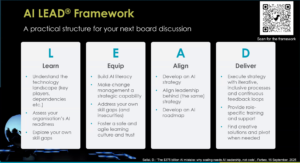
Dorottya developed the AI LEAD® framework to help leaders approach these issues. It has four stages and, although it is shown in sequence, it is not linear.
- Learn. Understand the technology, its dependencies and your own AI readiness, then explore the skill gaps of your teams and organisation
- Equip. Build AI literacy and Change Management capabilities within the transformation, and start using the technology yourself
- Align. The biggest problem in rollouts. Complete centralisation is not the answer, but everyone needs to head in the same direction
- Deliver. Create a culture of learning and openness where people are allowed to fail, in other words psychological safety
The framework also helps leaders set measurable indicators. Work through each stage and ask what would show you have mastered it.
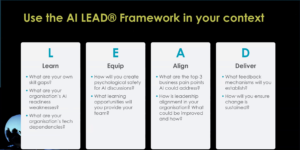
Resist the hype and ask why
Leaders should resist the pressure to jump into systems because everybody else is. In a recent leadership workshop, leaders from one global company arrived expecting to be told how to roll out a system on the brink of launch. After a couple of hours with the framework, they made three significant changes:
- The rollout approach, once they realised how crucial the impact is on individual employees
- The communication strategy, which now covers vulnerabilities and the impact on people, not only productivity
- Where AI is used, with conscious decisions about the tasks and roles where it helps, and where it will not be used at all
Protecting talent and human judgement
Automatable work tends to sit with junior roles. Automating the start of the talent pipeline creates a succession planning problem for middle management and loses skills that feed into teams later.
Research also shows a growing tendency to become dependent on AI, delegating our judgement to it. Dorottya builds AI-free sections into her students’ learning and increasingly recommends AI-free phases and processes to business leaders. Recruitment shows the risk: by the time a person makes a judgement, AI has already narrowed the pool, so how do you avoid losing the top talent the system has never seen before?
Emerging research also suggests an AI strategy is useful, but organisational agility matters more. That makes the role of Change Managers increasingly important.
Where to start if you are new to leading AI
- Set it up on your terms. Check how your data is stored, your privacy level and whether your data is used for training
- Check the results, and guard your own thinking. Generative systems will always hallucinate, and they tend to homogenise our thinking and wording
- Understand the impact on the people who will use it. Ask how employee experience, communication, decision-making, authority and control will change
Rethink the roles first
The use cases that create the most value involve augmenting, combining human and AI skills. IKEA, for example, integrated AI by redesigning the processes and roles of the people using the systems, rather than laying people off.
Many organisations introduce AI and then rethink the roles, when they should do it the other way around. Ask people how AI can help them, work with them to improve their workflows and include them in decisions about which system to use.
Leading with intention
The thread running through all of this is intention: understanding the impact of AI as well as you can and designing deliberately, with augmentation as a strong starting point. All of it rests on organisational agility, so leaders and organisations can keep learning in a world that will keep changing.
Watch the full session
🎬 Members can read the full article and watch the recording on the MEMBER HUB
🤔 Not a member yet? Now is a great time to JOIN HERE NOW